
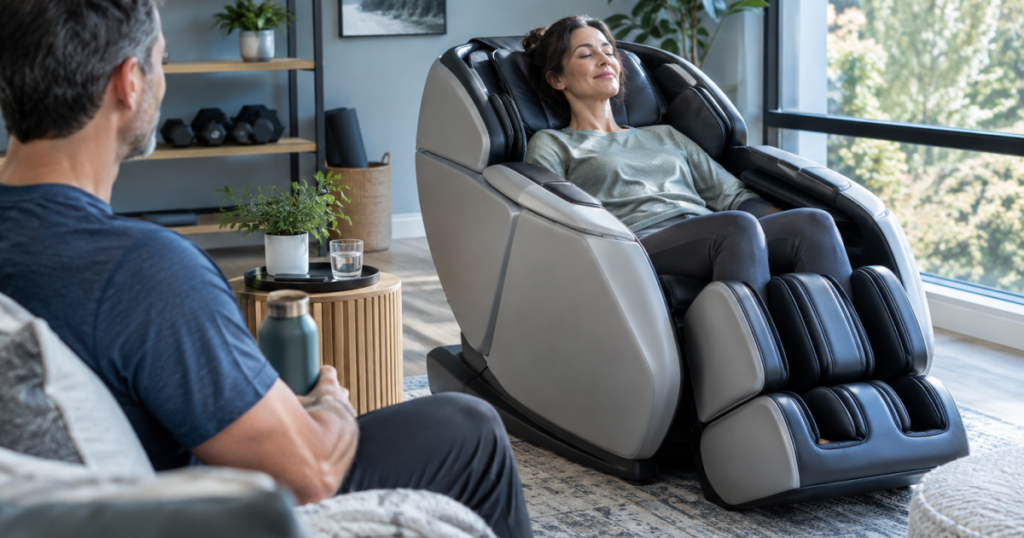
A home recovery room does not have to look like a spa suite or occupy a dedicated wing of the house. Its appeal is simpler: a private, ready-to-use space where a massage chair, low light, quiet sound, and a few repeatable habits make recovery feel less like an errand and more like a natural part of the day. For many owners, the luxury is not drama. It is not needing to schedule, drive, explain, wait, or perform relaxation for anyone else.
The best spaces are not built around showing off a premium chair. They are built around making the next session easy. When the chair is placed well, the room feels calm, and the routine is clear, a 15- or 20-minute session becomes something you actually repeat after workouts, long workdays, travel, or the ordinary tension of sitting too long.
Comfort-focused routines are not medical treatment, and a massage chair should not be used as a substitute for diagnosis or care. If pain, numbness, injury, circulation concerns, or other health issues are part of the picture, diagnosis and treatment decisions should be handled by a qualified healthcare professional in line with appropriate medical standards.
In brief
The strongest reason to create a dedicated recovery space is consistency. A premium chair can feel impressive on its own, but the room around it decides whether it becomes a daily ritual or an occasional novelty. Privacy helps your body stop bracing. Convenience removes friction. Ritual gives each session a beginning, middle, and end, so you are not just pressing an automatic program and hoping it matches your mood.
- Privacy makes it easier to relax without conversation, bright screens, or household traffic pulling attention away.
- Convenience means the chair is plugged in, accessible, and ready without moving furniture or clearing clutter.
- Ritual turns massage time into a repeatable sequence: water, chair settings, lighting, breathing, and a gentle transition back into the day.
Why privacy changes the feel of a chair session
Massage chair comfort is partly mechanical: roller position, pressure depth, recline angle, leg fit, and how the program moves along the back. But the experience is also environmental. A chair that feels refined in a quiet showroom can feel less restorative if it sits beside a blaring television, a pile of laundry, or a path everyone uses to reach the garage.
Privacy does not require isolation. It can be as modest as placing the chair so your face is not aimed at a busy doorway, keeping the remote within easy reach, and choosing a time of day when the room naturally quiets down. The goal is to remove the small social interruptions that keep your shoulders lifted and your breathing shallow.
If you are still shopping, fit testing matters before you imagine the perfect corner. A good showroom trial should check shoulder alignment, pressure range, calf and foot comfort, and whether the reclined position feels secure rather than trapped. The 20-minute showroom test is a useful way to slow down the decision and notice whether a chair actually supports the kind of calm routine you want at home.
Convenience is the quiet luxury
A recovery corner fails when it asks too much of you. If you have to pull the chair away from the wall, find the remote, move a side table, silence a device, and negotiate with the dog before every session, the routine will lose to the couch. Convenience is not laziness; it is design discipline.
Start with the path into the room. A chair that reclines deeply needs clearance, and a large massage chair should not make the room feel like an obstacle course. Keep enough open space to sit down comfortably, swing your legs into position, and exit without twisting around furniture. A floor mat can help visually anchor the chair and protect flooring, but the bigger win is defining the area as intentional rather than leftover.
Power access matters too. Avoid stretching cords across walking paths, and give the chair a stable place where controls, cup of water, reading glasses, and a phone on silent can live nearby. The more the room says, “everything is ready,” the less willpower the habit requires.
What a home recovery room actually does
A well-planned room gives your nervous system fewer jobs. It lowers the number of decisions between wanting relief and starting a session. That is the practical appeal: one place, one chair, one familiar sequence, and a predictable atmosphere.
For a post-workout session, that might mean changing shoes, drinking water, choosing a lower-to-moderate intensity program, and letting the chair focus on general comfort rather than chasing maximum pressure. For an after-work reset, it might mean dimming the lights, using a quieter program, and keeping the first few minutes gentle so the body has time to stop guarding. For an evening wind-down, the routine might avoid intense settings and bright screens, ending with a brief stretch before bed.
The same chair can serve each of those moments, but the room helps tell your body which version of the routine you are entering.
The ritual: small steps that make sessions feel complete
Ritual sounds grand, but the useful version is almost boring. Repeat the same simple steps until they become automatic. That repetition is what makes the room feel personal instead of staged.
Before the session
- Decide the purpose in one sentence: unwind, reset after movement, or prepare for sleep.
- Drink water if you have been exercising or sitting for a long stretch.
- Empty pockets and remove bulky layers that interfere with the backrest or leg wells.
- Set the room: lower the lights, reduce noise, and put notifications out of reach.
During the session
- Start easier than your ego wants. Stronger is not automatically better.
- Use manual adjustments if the rollers miss your shoulders or feel too high or low.
- Let your hands rest instead of scrolling through the whole program.
- Notice pressure quality: comfortable intensity should feel purposeful, not like endurance training.
After the session
- Sit upright for a moment before standing.
- Do one or two gentle mobility movements if they feel natural.
- Make a quick note if a setting worked especially well.
- Leave the space tidy so the next session starts easily.
Choosing a chair with the room in mind
The room and the chair should be chosen together. A chair that offers impressive features on paper may still be frustrating if the reclined footprint overwhelms the space, the foot section does not suit the primary user, or the controls feel too fussy for a tired evening routine.
This is where comparison shopping should move beyond feature count. Look at supported user height, weight guidance, upright and reclined depth, track style, heat areas, zero-gravity positions, and warranty structure when those details are available from the seller or manufacturer. Those specifications do not predict comfort perfectly, but they help you rule out poor fits before delivery. The 4D Massage Chair Comparison Center is designed for that kind of structured comparison, especially when you are weighing fit, footprint, and ownership factors rather than chasing the longest feature list.
For shared households, treat the chair like a shared instrument. One person may prefer broad, gentle coverage after work; another may want more targeted intensity after strength training. The better routine is not the one with the most dramatic program. It is the one each person can adjust without turning relaxation into a settings project.
Common mistakes that make the space less restorative
The most common mistake is placing the chair where there is room left over instead of where relaxation is likely. A basement corner, guest room, bedroom nook, or office can all work, but only if the space feels accessible and calm enough to use regularly.
- Making the chair compete with screens. A television can be pleasant for some sessions, but constant visual stimulation may keep an evening routine from feeling restful.
- Using high intensity every time. A premium 4D mechanism is valuable because it offers range, not because every session needs to be forceful.
- Ignoring noise and light. Harsh overhead lighting and hard surfaces can make a room feel clinical rather than restorative.
- Skipping fit adjustments. If the body scan or shoulder position feels off, make a manual adjustment instead of tolerating a program that never quite lands.
- Letting clutter return. A recovery space should not become the chair-shaped version of a spare shelf.
Who gets the most from this kind of space?
A dedicated recovery area is especially valuable for people who already know they will use brief routines more consistently than occasional long sessions. Home gym users may appreciate a place to transition out of training mode. Desk workers may value a firm boundary between work posture and evening calm. Couples or families sharing one chair may benefit from separate preferred settings and a simple etiquette rule: when someone is in the chair, the room stays quiet.
It also suits shoppers who see a massage chair as part of home comfort rather than a miracle device. That mindset leads to better ownership. You are not asking the chair to fix everything; you are building a space where comfort is easier to choose repeatedly.
Why it matters
The appeal of a home recovery room is not only the chair. It is the privacy to relax without being observed, the convenience of starting without preparation, and the ritual that makes the session feel complete. Those three elements help a premium massage chair become a lived-in part of the home rather than an impressive object that slowly gathers dust.
Before buying or rearranging, picture the ordinary Tuesday version of the routine. Where will you sit down? What will you move out of the way? How bright is the room? Who might interrupt? Which settings will you choose when you are tired and do not want to think? Good answers to those questions are what make the space last.
Because this site may earn from qualifying recommendations, it is worth understanding the editorial and affiliate model behind product links; the Affiliate Disclosure explains that relationship clearly.