
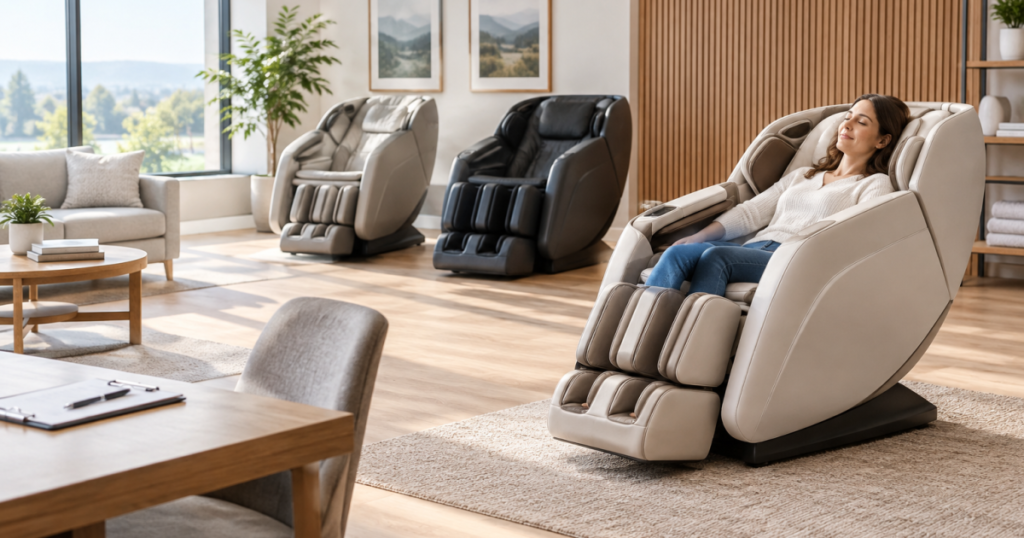
A massage chair can feel impressive in the first thirty seconds and still be wrong for your body after delivery. The 20-minute showroom test gives you a calm, repeatable way to check the three things that matter most for daily comfort: whether the rollers find your shoulders, whether the pressure range has enough useful control, and whether your legs sit naturally in the calf and foot section.
The goal is not to find the most dramatic program in the store. It is to learn whether the chair can become part of a routine you will actually enjoy: a gentler evening wind-down, a firmer post-workout session, or a shared household setup where two people need very different intensity levels.
What to know first
A good showroom trial should answer one practical question: can this chair adapt to your body without constant compromise? In twenty minutes, you will not learn everything about long-term ownership, but you can catch the common fit issues that make even expensive chairs disappointing at home.
Focus on body contact, not feature count. 4D roller language, body scanning, air compression, heat zones, and zero gravity positions can all matter, but the chair still has to place pressure where your body expects it. If the rollers consistently miss the top of your shoulders, the deepest setting feels sharp instead of controlled, or your knees and ankles fight the leg rest, the rest of the feature sheet becomes less persuasive.
Before visiting, shortlist chairs by broad fit and ownership factors rather than brand excitement alone. The 4D Massage Chair Comparison Center is useful for comparing structured details such as chair type, footprint, supported user range, heat areas, and warranty summary before you decide what deserves showroom time.
Run the 20-minute showroom test in this order
Minutes 0 to 3: Set up the chair like you would at home
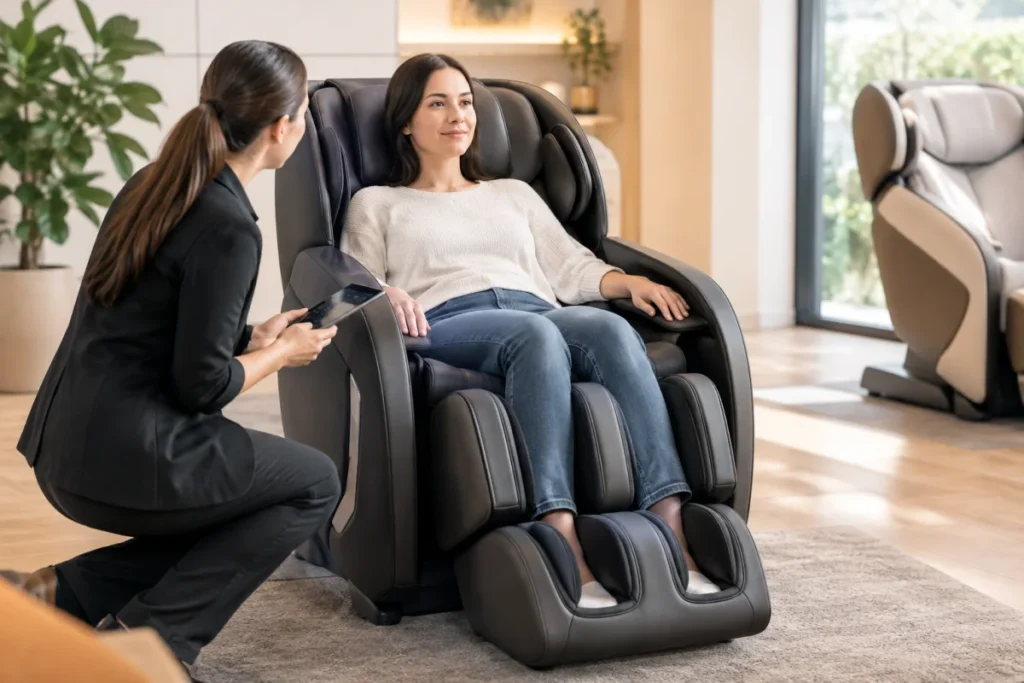
Sit normally before the program starts. Place your hips fully back in the seat, let your shoulders rest naturally, and keep your feet flat in the foot wells if the chair design allows it. Do not slouch to make the chair feel better. If you have to perform a perfect showroom posture to get a decent massage, the fit may be too fussy for relaxed everyday use.
Ask the salesperson to show you how to adjust intensity, roller position, and recline without taking over the entire session. You are checking whether the controls are understandable when you are already reclined, not whether someone else can rescue the experience from the showroom floor.
Minutes 3 to 7: Check whether the body scan finds your shoulders
The shoulder scan is one of the most important early checks. After the chair completes its scan, notice where the rollers begin working near the base of your neck and upper shoulders. The pressure should land around the muscular area beside the spine, not jab high into the neck or start too low between the shoulder blades.
If the rollers are slightly off, use the manual shoulder-position adjustment if the chair offers one. A chair does not have to scan perfectly on the first attempt to be usable, but it should be easy to correct. If the adjustment range still leaves the rollers too high or too low, note that immediately. That is a real fit concern, especially for very tall, petite, or long-torso users.
- Good sign: the rollers can be placed comfortably at the upper shoulders after a quick adjustment.
- Warning sign: the massage feels like it is chasing your neck or missing your shoulders entirely.
- Shared-household check: each person should run their own scan, because one good result does not prove the chair fits everyone.
Minutes 7 to 12: Test the usable pressure range
This is where 4D adjustability should become meaningful. Start at a low or medium intensity, then gradually move up. You are looking for a range of settings that feel distinct without jumping from too soft to too aggressive. A premium chair should give you a calm path from gentle contact to deeper pressure, not a cliff edge.
Pay attention to the difference between deep and sharp. Deep pressure can feel firm, grounded, and deliberate. Sharp pressure feels pointy, bony, or distracting, especially around the shoulder blades, lower back, or glutes. If the chair only feels good when you brace against it, that may not translate into the restorative routine you imagined.
Try at least one automatic program and one manual adjustment. Automatic programs reveal the chair’s default personality. Manual control shows whether you can tame or focus that personality when your body wants something specific. For many owners, that adjustability is what keeps the chair useful after the novelty period.
Minutes 12 to 16: Check calf, knee, and foot comfort
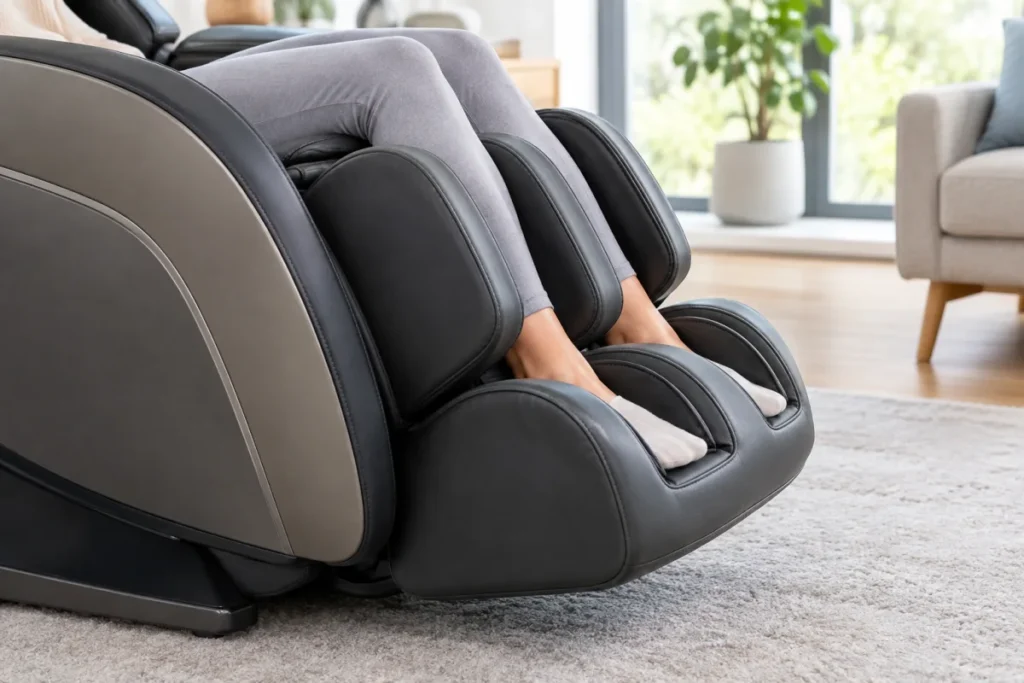
Leg fit is easy to overlook because the back massage grabs your attention first. Give the lower-body section several quiet minutes. Your calves should sit without being squeezed into an awkward angle, your knees should not feel lifted or crowded, and your feet should not feel forced forward or curled back.
If the footrest extends or adjusts, let it move naturally and then fine-tune it. Do not judge only by whether your legs technically fit. Judge whether they can relax. Taller users should watch for cramped knees and short extension. Shorter users should check whether the feet make meaningful contact without sliding forward. Broad calves or sensitive feet also deserve a slower compression test rather than a quick yes or no.
Minutes 16 to 19: Recline, listen, and picture the room
Move the chair through its recline positions and notice how your body weight shifts. A comfortable recline should make the massage feel supported, not make you feel trapped. Also listen for mechanical noise, airbag cycling, and any sounds that would matter in the room where the chair will live. Showrooms are not identical to homes, but they can still reveal whether the chair’s motion feels smooth and composed or busy and distracting.
Use this moment to imagine placement. Will the chair sit in a quiet bedroom corner, a media room, a home gym recovery space, or a shared living area? A strong showroom experience can fade if the chair blocks a walkway, feels too large for the room, or is too loud for the routine you want.
Minute 19 to 20: Write the verdict before you stand up
Before trying another model, capture quick notes on your phone. Rate shoulder placement, pressure control, leg fit, control ease, recline comfort, and overall relaxation from 1 to 5. Add one plain-language sentence: what felt best, what bothered you, and who in the household might disagree.
This small habit prevents the showroom blur. After three chairs, the dramatic program, the helpful salesperson, and the shiny finish can start to blend together. Your notes keep the decision anchored to your body.
How to judge the results
A chair that passes does not need to be perfect in every category. It should, however, have no deal-breaking fit problem and at least one pressure style you can imagine using several times a week. The strongest candidates usually feel adjustable rather than theatrical. They let you soften the session on tired days and add depth when you want more focused pressure.
If you are comparing a model with known fit boundaries, read beyond the spec sheet. For example, our Kyota Kiyomi M698 4D Massage Chair Review looks closely at comfort strengths and real fit limits, which is exactly the kind of context to pair with showroom notes.
If another chair feels close but not quite right, compare its profile rather than assuming all premium 4D models will behave the same. The Infinity Sovana 4D DualPro Massage Chair page is one example of how a model-specific listing can help you organize features, fit expectations, and ownership details before a second visit.
Common mistakes that distort a showroom trial
- Starting with the most intense program: a dramatic first impression can hide whether the chair has a comfortable low and medium range.
- Testing while tense: if your shoulders are lifted or your feet are braced, the chair is not reading your normal resting posture.
- Letting the salesperson run everything: you need to know whether you can adjust the chair yourself when you are tired.
- Ignoring the second user: shared chairs should be tested by each primary user, not chosen by the person with the strongest preference.
- Confusing more pressure with better massage: the right pressure feels controlled and sustainable, not simply forceful.
- Forgetting delivery reality: a chair that feels wonderful still needs to fit through the delivery path and into the room where it will be used.
When to walk away
Walk away from a showroom favorite if the rollers cannot be placed comfortably at your shoulders, if the lowest useful setting still feels too aggressive, or if the leg section forces your knees, calves, or ankles into a position you would not want for a full session. These are not small quirks. They are the exact issues that tend to become daily friction.
Also be cautious if the chair only feels good with constant staff adjustment. A premium massage chair should feel inviting once you understand the controls. If every comfortable moment requires someone else to intervene, the ownership experience may feel less luxurious than the showroom performance.
Common questions
Should I test more than one chair in the same visit?
Yes, but limit the session to two or three serious candidates. After that, your body may become less sensitive to the differences. Take notes between chairs and avoid back-to-back maximum-intensity programs.
What should I wear to a showroom test?
Wear normal, comfortable clothing similar to what you would wear at home. Very bulky jackets, thick belts, and items in back pockets can distort how the rollers feel against your body.
Is a 4D chair always better for pressure control?
Not automatically. 4D generally refers to roller depth variation added to movement and technique, but implementation varies by model. What matters in the showroom is whether the chair gives you a useful range of comfortable pressure.
Can a showroom test prove long-term comfort?
No. It can reduce risk by identifying obvious fit and feel problems before purchase. Long-term satisfaction also depends on room placement, routine, controls, delivery experience, warranty support, and how consistently the chair suits the people using it.
A calm next step
The best showroom visit feels measured, not rushed. Give each chair the same twenty minutes, use the same checks, and let your notes carry more weight than the most exciting single feature. When the rollers land well, the pressure range feels usable, and the leg section lets your body settle, you are much closer to choosing a chair that feels like a restorative part of the room instead of an expensive experiment.